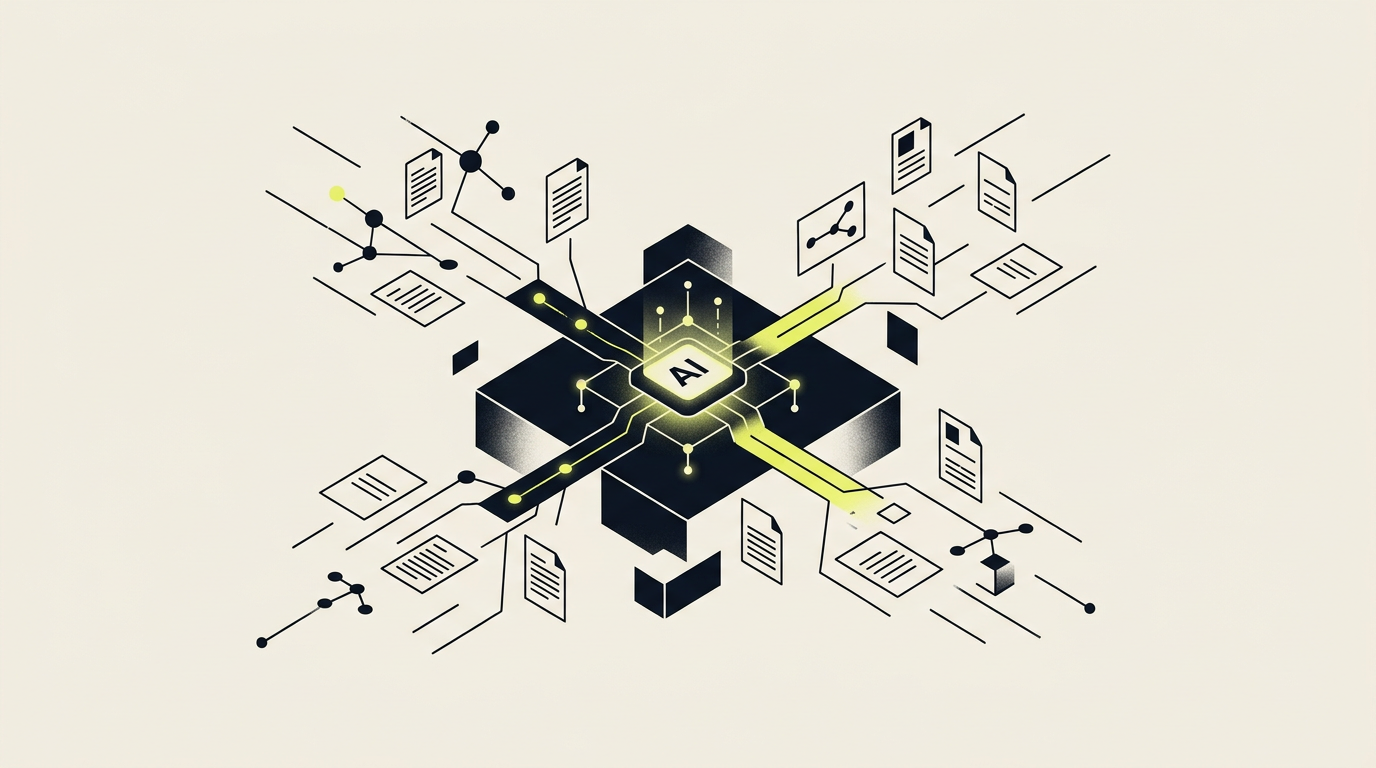
GraphRAG, or Knowledge Graph Retrieval-Augmented Generation, is an advanced form of RAG that integrates large language models (LLMs) with structured knowledge graphs to enhance the accuracy, relevance, and explainability of AI-generated responses. It is particularly crucial for enterprise AI in 2026 by moving beyond simple semantic similarity to leverage explicit relationships and inferential capabilities inherent in knowledge graphs, providing more precise and contextually rich information for internal AI copilots and automated systems.
Beyond Basic RAG: The GraphRAG Advantage in 2026
Traditional Retrieval-Augmented Generation (RAG) systems primarily rely on vector databases and semantic search to retrieve relevant document chunks based on query similarity. While effective for many applications, this approach has inherent limitations, especially when dealing with complex, interconnected enterprise data. Vector embeddings can sometimes miss nuanced relationships or inferential links that are vital for accurate context.
This is where GraphRAG steps in as a significant evolution. Instead of merely retrieving text snippets, what is GraphRAG knowledge graph retrieval augmented generation definition? It is a methodology that pre-processes enterprise data into a structured knowledge graph, where entities (people, products, concepts), relationships (e.g., "employs," "manufactures," "is a part of"), and properties are explicitly defined. When a query comes in, the RAG pipeline interacts with this graph, not just a flat text index. This allows the system to identify not just keywords, but the contextual relationships between them, leading to richer, more accurate, and verifiable responses.
For example, a traditional RAG system might retrieve documents mentioning "Project X" and "Team Lead Sarah." A GraphRAG system, however, could retrieve information about "Project X," its current status, the specific tasks Sarah is assigned within that project, and any dependencies or team members linked to those tasks – all based on the explicit connections within the knowledge graph. This capability is paramount for sophisticated internal AI copilots operating within dynamic organizational knowledge bases.
Architecture & Core Components of a GraphRAG System
The construction of a robust GraphRAG system involves several distinct architectural components that work in concert:
1. Data Ingestion & Graph Construction
This is the foundational step. Raw enterprise data – structured (databases, CRMs), semi-structured (JSON, XML), and unstructured (documents, emails, PDFs) – must be transformed into a graph format. This typically involves:
- Entity Extraction: Identifying key entities within the text (e.g., company names, product IDs, project codes, people).
- Relationship Extraction: Identifying how these entities relate to each other (e.g., "Company A acquired Company B," "Employee X is part of Project Y").
- Property Extraction: Extracting attributes of entities and relationships (e.g., "Project Y has status 'In Progress'").
- Semantic Triple Generation: Representing extracted facts as subject-predicate-object triples (e.g., (Company A, acquired, Company B)).
2. Graph Database Selection
Unlike vector databases, GraphRAG requires a dedicated graph database to store and manage the interconnected data. Popular choices in 2026 include:
- Neo4j: A leading native graph database known for its powerful Cypher query language and robust ecosystem.
- AWS Neptune: A fully managed graph database service supporting Apache TinkerPop Gremlin and SPARQL.
- ArangoDB: A multi-model database that supports graph, document, and key-value data models.
- Azure Cosmos DB (Graph API): Microsoft's global-scale, multi-model database supporting Gremlin.
3. Graph Querying & Contextual Retrieval
When an LLM receives a user query, the GraphRAG pipeline initiates a retrieval process. Instead of just a vector search, this involves executing sophisticated graph traversal queries (e.g., using Cypher, Gremlin, or SPARQL) on the knowledge graph. The goal is to identify relevant subgraphs, paths, or connected entities that provide the most pertinent context to the user's question. This is where how does retrieval augmented generation work in a GraphRAG context becomes distinct: it retrieves a rich, structured context, not just text snippets.
4. LLM Integration & Prompt Engineering
The retrieved graph data (often serialized into a textual format like triples or a natural language summary of the subgraph) is then fed into the LLM as additional context alongside the user's original query. Prompt engineering becomes crucial here to instruct the LLM on how to interpret and synthesize this structured graph information into a coherent, accurate, and contextually rich response. The LLM then generates the final answer, leveraging both its foundational knowledge and the specific, verified facts from the knowledge graph.
Implementing GraphRAG for Enterprise Knowledge Bases
Implementing a GraphRAG system is a multi-stage process that requires careful planning and execution. Here’s a practical breakdown:
Phase 1: Knowledge Modeling & Schema Design
Before building, you must design your graph. This involves defining:
- Entities: What are the key objects of interest in your domain (e.g., employees, projects, documents, departments, clients)?
- Relationships: How do these entities connect (e.g.,
WORKS_ON,MANAGES,IS_PART_OF,OWNS)? - Properties: What attributes do entities and relationships have (e.g.,
employee_id,project_status,document_date)?
A well-defined schema is critical for ensuring data consistency and query efficiency.
Phase 2: Data Sourcing & Ingestion
Identify all relevant data sources. This often requires building custom ETL (Extract, Transform, Load) pipelines to:
- Extract: Pull data from various enterprise systems.
- Clean & Standardize: Address inconsistencies, duplicates, and missing values.
- Transform: Convert data into graph-ready formats (e.g., extracting semantic triples). For unstructured text, this involves advanced NLP techniques like named entity recognition (NER) and relationship extraction (RE).
- Load: Populate the chosen graph database.
Phase 3: Graph RAG Pipeline Development
This involves developing the core logic that orchestrates retrieval:
- Query Analysis: Understanding the user's intent from the natural language query.
- Graph Query Generation: Translating user intent into efficient graph database queries.
- Retrieval Strategies: Defining how relevant information is extracted from the graph (e.g., retrieving direct neighbors, traversing paths, identifying specific subgraphs).
- Contextualization: Formatting the retrieved graph data into a coherent context block for the LLM.
Phase 4: LLM Integration & Optimization
Integrate the context with your chosen LLM (e.g., GPT-4, Claude 3, Llama 3). This stage focuses on:
- Prompt Engineering: Crafting effective prompts that leverage the structured graph context and instruct the LLM on how to use it.
- LLM Selection: Choosing an LLM that aligns with your performance, cost, and security requirements.
- Response Generation & Refinement: Iteratively testing and refining the LLM's output to ensure accuracy, coherence, and adherence to desired tone.
Phase 5: User Interface & Internal AI Copilots
Deploy the GraphRAG system through intuitive interfaces. For internal use, this often means creating specialized internal AI copilots that allow employees to query the knowledge graph directly or receive proactive insights. These copilots can be integrated into existing workflows, communication platforms, or dedicated dashboards, making complex enterprise knowledge easily accessible.
Establishing Robust Governance for GraphRAG Systems
Implementing advanced AI systems like GraphRAG without a strong governance framework can lead to significant risks, including data inaccuracy, security breaches, and ethical dilemmas. Who can implement governance for retrieval-augmented generation within an organization? Typically, a cross-functional team involving data architects, AI engineers, legal counsel, and business unit leaders collaborates to define and enforce these policies.
1. Data Governance for Knowledge Graphs
- Data Quality: Establish rigorous processes for data validation, cleanliness, and completeness during ingestion and ongoing maintenance.
- Data Security & Access Control: Implement granular permissions to ensure sensitive graph data is only accessible to authorized personnel.
- Data Privacy: Ensure compliance with data protection regulations (e.g., GDPR, CCPA) by anonymizing or pseudonymizing sensitive personal information within the graph.
- Provenance & Lineage: Maintain clear records of data sources and transformations, enabling traceability of information within the graph.
2. Model Governance for LLM & Graph Interaction
- Bias Detection & Mitigation: Regularly audit LLM outputs and graph retrieval processes for potential biases that could lead to unfair or discriminatory results.
- Explainability & Interpretability: Develop mechanisms to trace an LLM's response back to the specific subgraph or entities that informed it, enhancing trust and auditability.
- Version Control & Updates: Manage different versions of the knowledge graph schema, data, and LLM prompts, ensuring smooth transitions and rollback capabilities.
- Performance Monitoring: Continuously monitor the accuracy, latency, and relevance of GraphRAG responses, setting clear KPIs for success.
3. Ethical AI & Compliance
- Transparency: Clearly communicate to users when they are interacting with an AI system and how its responses are generated.
- Fairness: Ensure the GraphRAG system does not perpetuate or amplify societal biases.
- Accountability: Define clear lines of responsibility for the system's performance and any unintended consequences.
- Regulatory Adherence: Stay abreast of evolving AI regulations and ensure the GraphRAG system adheres to all relevant legal and ethical standards.
4. Performance Monitoring & Audit Trails
Crucial for maintaining a healthy GraphRAG system are comprehensive monitoring and logging capabilities. This includes:
- Retrieval Quality Metrics: Measuring the precision and recall of graph queries.
- LLM Output Quality: Evaluating the factual accuracy, coherence, and helpfulness of generated responses.
- System Health: Monitoring database performance, pipeline latency, and resource utilization.
- Audit Trails: Logging all user interactions, retrieved contexts, and LLM responses to facilitate debugging, compliance checks, and post-incident analysis.
Real-World Use Cases in 2026
GraphRAG is transforming how enterprises leverage their knowledge:
- Customer Support & Service Desks: Powering sophisticated chatbots and internal AI copilots that can answer complex customer queries by connecting product information, troubleshooting guides, customer history, and internal expert knowledge, leading to faster resolution times.
- Research & Development Intelligence: Assisting researchers by connecting disparate scientific papers, patent data, internal research reports, and experimental results to uncover novel insights and accelerate innovation.
- Legal & Compliance Analysis: Analyzing vast repositories of legal documents, contracts, and regulatory filings to identify specific clauses, obligations, or risks, ensuring compliance and aiding due diligence processes.
- Financial Services: Enhancing fraud detection by analyzing complex transaction networks, identifying suspicious patterns and relationships that traditional methods might miss.
Challenges & Future Trends
While powerful, GraphRAG implementations present challenges, including the initial effort for graph schema design, data ingestion complexity, and the need for specialized skills. Scalability of graph databases and maintaining graph consistency as data evolves are ongoing considerations.
Looking ahead, advancements in automated knowledge graph construction, more intelligent graph query generation, and seamless integration with multimodal LLMs will continue to push the boundaries of what GraphRAG can achieve, making rag pipelines even more sophisticated and indispensable for enterprise knowledge management.
Frequently Asked Questions (FAQ)
What's the main difference between RAG and GraphRAG?
Traditional RAG typically uses vector databases for semantic similarity search on text chunks. GraphRAG, however, leverages a structured knowledge graph to retrieve context based on explicit relationships and inferences between entities, leading to more precise, factually grounded, and explainable responses.
Is GraphRAG suitable for small businesses?
While the initial setup for GraphRAG can be more resource-intensive than basic RAG due to knowledge graph construction, its benefits in accuracy and contextual understanding can be valuable for small businesses with complex, interconnected data. Tools and services are becoming more accessible, and targeted implementations for critical knowledge domains can provide significant ROI.
What skills are needed to implement GraphRAG?
Implementing GraphRAG requires a multidisciplinary team. Key skills include data engineering (for ETL and data pipeline creation), graph database expertise (schema design, querying), natural language processing (for entity/relationship extraction), LLM operations (prompt engineering, model integration), and strong project management.
How long does a typical GraphRAG implementation take?
The timeline for GraphRAG implementation varies significantly based on data volume, complexity of the knowledge domain, data cleanliness, and existing infrastructure. A proof-of-concept might take a few weeks, while a full-scale enterprise deployment for a comprehensive knowledge base could span several months.
Empowering Your Enterprise with Intelligent Knowledge
GraphRAG represents a significant leap forward in how enterprises can leverage their vast troves of data. By moving beyond mere keyword matching to understanding the intricate relationships within your knowledge base, you can empower your internal AI copilots with unparalleled accuracy and contextual intelligence. Establishing robust governance ensures these powerful systems operate ethically, securely, and effectively.
If your organization is grappling with complex data and seeking to unlock its full potential through advanced AI, PixelorCode specializes in designing, implementing, and governing bespoke GraphRAG solutions. We help you build intelligent knowledge systems that drive precision and efficiency. Contact PixelorCode to explore how GraphRAG can transform your enterprise AI strategy in 2026.