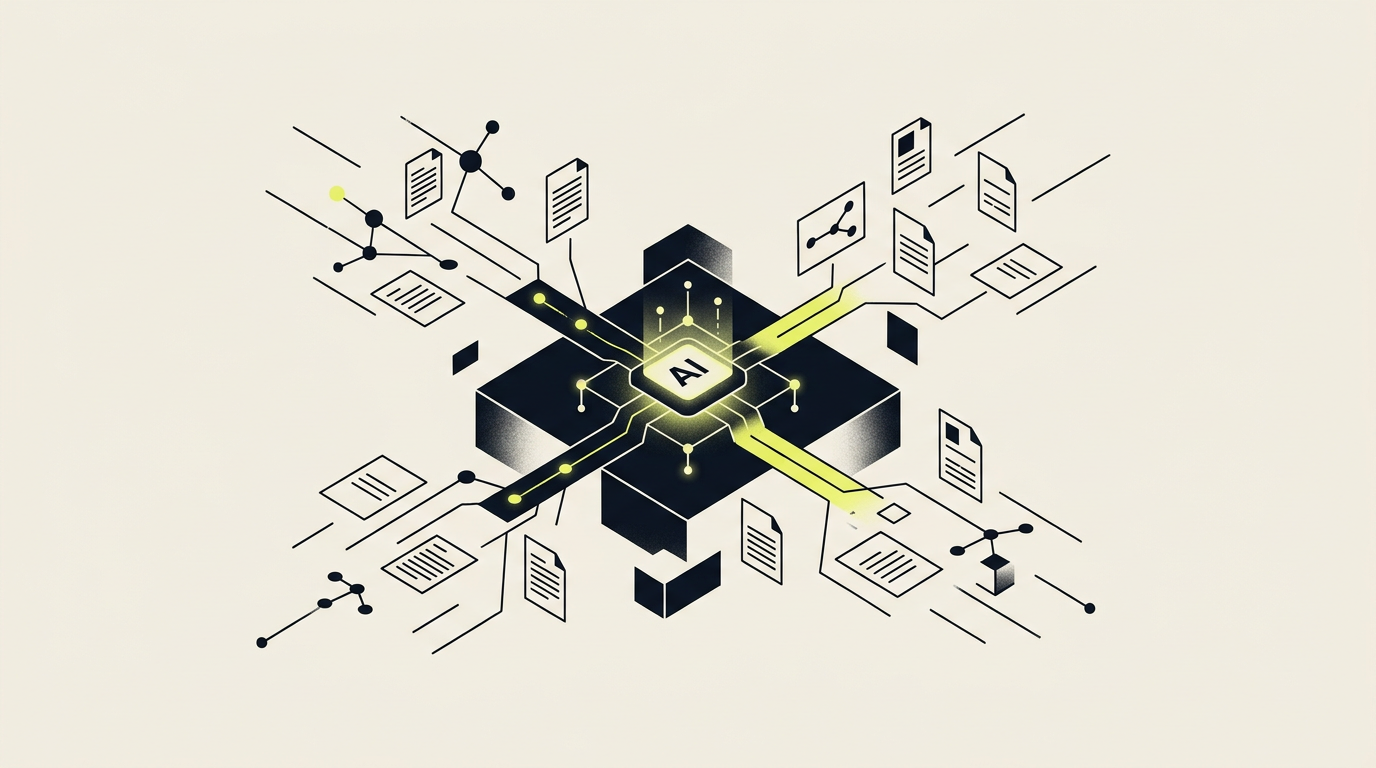
An internal AI copilot uses Retrieval-Augmented Generation (RAG) to securely search your company's proprietary data and formulate accurate, context-aware answers. By connecting large language models (LLMs) directly to your internal knowledge bases—like Notion, Slack, Jira, and Google Drive—RAG ensures employees receive instant, source-backed information without exposing private data to public AI models.
In 2026, generic AI chatbots are no longer sufficient for enterprise productivity. Employees don't just need an AI that can write emails; they need an AI that knows your specific HR policies, understands your past project post-mortems, and can instantly pull technical documentation for your proprietary software.
This is where RAG becomes the foundational architecture for modern business intelligence. If you are looking to build a secure, hallucination-free AI assistant for your team, this is a simple guide to retrieval augmented generation and how to deploy it effectively.
The Shift to Internal AI Copilots in 2026
For the past few years, businesses attempted to use custom instructions or basic prompt engineering to make AI models useful for internal tasks. The limitation was always context. An LLM like GPT-4o or Claude 3.5 Sonnet has a finite memory window and cannot inherently "know" about a document created in your company yesterday.
RAG AI solves this by decoupling your data from the AI model itself. Instead of trying to teach (or fine-tune) the model to memorize your company data—which is costly, slow, and prone to hallucinations—RAG acts as a highly intelligent librarian. It finds the exact paragraph in your database that answers a question, hands that paragraph to the LLM, and instructs the LLM to summarize it.
This architecture provides three massive advantages for internal copilots:
- Verifiable Accuracy: Because the AI generates its answer based on retrieved documents, it can cite its sources (e.g., "According to the Q3 QBR Report, page 4").
- Dynamic Updates: If a policy changes, you simply update the document in your database. The copilot instantly knows the new policy without retraining.
- Granular Security: You can restrict which documents the AI is allowed to retrieve based on the user's role.
How Retrieved Documents Are Used in Retrieval Augmented Generation
To understand the mechanics of an internal copilot, it is crucial to understand exactly how retrieved documents are used in retrieval augmented generation.
The process follows a strict sequence every time an employee types a query into the copilot interface:
1. The User Query and Semantic Search
When a user asks, "What is our standard SLA for enterprise web development?", the system does not send this question directly to the LLM to guess the answer. Instead, it converts the question into a mathematical vector (an embedding) and searches your vector database (e.g., Pinecone, Weaviate) for chunks of company documents that have a similar mathematical meaning.
2. Document Retrieval and Ranking
The database retrieves the most relevant "chunks" of text—perhaps a paragraph from a 2024 client contract, a bullet point from an internal Notion wiki, and a snippet from a sales playbook. These retrieved chunks are then ranked by relevance using advanced algorithms like cross-encoders to ensure only the most accurate context is prioritized.
3. Context Injection (The Prompt)
This is where the "Augmented Generation" happens. The system creates a temporary, hidden prompt that packages the user's original question alongside the retrieved documents.
It looks something like this behind the scenes:
"You are a helpful internal assistant for PixelorCode. Answer the user's question using ONLY the provided context. If the answer is not in the context, say you do not know. Context 1: [Snippet from SLA Wiki] Context 2: [Snippet from Client Contract] User Question: What is our standard SLA for enterprise web development?"
4. Generation and Citation
The LLM reads the injected documents, formulates a natural language response, and outputs the answer to the user, complete with hyperlinks back to the original source files. Once the chat session ends, the LLM retains none of this private data.
Advancing to GraphRAG (Knowledge Graphs)
Standard vector-based RAG is excellent for finding specific facts, but it struggles with complex, multi-hop reasoning. If an employee asks, "How did the bottlenecks in the Alpha Project compare to the Beta Project?", standard RAG might fail because the answer isn't in a single document—it requires connecting the dots across dozens of meeting notes, Slack threads, and Jira tickets.
In 2026, the solution to this is GraphRAG.
GraphRAG combines traditional retrieval with Knowledge Graphs. Before a user ever asks a question, the AI scans your entire knowledge base and maps out entities (people, projects, clients, technologies) and their relationships. It creates a web of context. When the copilot retrieves documents, it uses this map to pull in horizontally related information, drastically reducing blind spots and enabling deep, analytical answers.
Standard RAG vs. GraphRAG Comparison
| Feature | Standard Vector RAG | GraphRAG (Knowledge Graph RAG) |
|---|---|---|
| Best For | Point-blank questions (e.g., "What is X?") | Complex reasoning (e.g., "How does X impact Y?") |
| Data Structure | Isolated chunks of text in a vector database | Interconnected nodes mapping relationships |
| Setup Complexity | Low to Medium | High (requires entity extraction pipelines) |
| Query Speed | Extremely fast | Slightly slower due to graph traversal |
| Hallucination Risk | Low (if context is found) | Near zero (due to structured relationship mapping) |
Structuring Your Enterprise Knowledge Base
An AI copilot is only as intelligent as the data it has access to. The most common reason AI implementations fail is poor data hygiene. Before deploying a copilot, you must structure your data pipeline.
1. Data Ingestion and Cleansing
You need automated pipelines to pull data from your SaaS tools. This involves stripping out formatting, removing obsolete files, and converting PDFs, docs, and spreadsheets into clean, machine-readable text.
2. Intelligent Chunking Strategies
You cannot feed a 100-page PDF into an LLM all at once efficiently. The text must be "chunked." In 2026, advanced semantic chunking is standard. Instead of cutting text arbitrarily every 500 words, semantic chunking uses AI to keep related concepts and paragraphs together, ensuring the retrieved documents make logical sense.
3. Metadata Tagging
Every document chunk needs metadata (author, date, department, project tags). This allows the copilot to perform "Hybrid Search." If a user asks for "Q3 financials," the system can filter exclusively for documents tagged with the finance department and the year 2026 before performing the semantic search.
Security and Access Control
A massive concern for businesses is ensuring the CEO's private strategy documents aren't retrievable by a junior intern. This brings up a critical question: who can implement governance for retrieval-augmented generation?
Governance should be a collaborative effort between your IT security team and your AI implementation agency. Implementing governance requires strict Role-Based Access Control (RBAC) at the vector database level.
When a user logs into the internal copilot, the system must pass their identity token (via SSO/SAML) to the retrieval engine. The database then acts as a filter, only surfacing document chunks that match the user's specific access permissions. If the user does not have clearance for the HR payroll folder, the vector search will physically bypass those documents, making it impossible for the LLM to generate an answer about them.
Step-by-Step: Deploying Your Internal AI Copilot
If you are ready to build an internal AI assistant, here is the strategic roadmap we use at PixelorCode:
- Phase 1: Scope and Audit. Identify the primary use case. Is this for customer support agents needing product specs, or for new hires needing onboarding materials? Audit the existing data sources (Zendesk, Confluence, Google Drive).
- Phase 2: Pipeline Engineering. Build the ETL (Extract, Transform, Load) pipelines to sync your unstructured data into a unified vector store or knowledge graph. Set up automated syncs so the database updates whenever a file is edited.
- Phase 3: RAG Architecture Selection. Decide between standard semantic search, hybrid search (keyword + vector), or a full GraphRAG implementation depending on the complexity of your team's queries.
- Phase 4: LLM and MCP Integration. Connect the retrieval pipeline to a frontier model (via API) and utilize Model Context Protocol (MCP) to allow the copilot not just to read data, but to take actions (like generating a Jira ticket based on a retrieved bug report).
- Phase 5: UI/UX and Testing. Deploy a custom, brand-aligned chat interface. Implement tracing and observability tools to monitor which documents are being retrieved and where the AI is failing to find answers.
At PixelorCode, we help creative and tech companies design, structure, and deploy these advanced AI systems. Pricing depends entirely on scope, the complexity of your data ecosystem, and the specific security infrastructure required.
FAQ: Understanding RAG in AI
What is RAG in AI?
Retrieval-Augmented Generation (RAG) is a framework that improves the accuracy of Large Language Models (LLMs) by grounding them in external, proprietary data. Instead of relying on the AI's pre-trained knowledge, RAG searches your specific company documents and feeds that information to the AI to formulate an accurate, source-backed answer.
Does RAG require training the AI model?
No. Does RAG train on your data? Absolutely not. This is the primary benefit of the architecture. RAG simply retrieves text and places it in the AI's temporary reading window (the context window). Once the answer is generated, the data is wiped from the AI's memory, ensuring total data privacy and zero model drift.
What is GraphRAG knowledge graph retrieval augmented generation definition?
GraphRAG is an advanced evolution of standard RAG. While standard RAG retrieves isolated chunks of text based on keyword or semantic similarity, GraphRAG first builds a "Knowledge Graph"—a structured map of entities (people, places, concepts) and how they relate to one another. When a query is made, it traverses this graph to retrieve holistic, interconnected context, allowing the AI to answer complex, multi-layered questions that standard retrieval would miss.
Why not just use custom GPTs?
Consumer-level custom GPTs allow file uploads, but they struggle with scale. If you upload hundreds of documents, their retrieval systems often miss critical information, lack proper metadata filtering, and do not integrate dynamically with your live databases (like Notion or Slack). Enterprise RAG pipelines are custom-coded to ensure high-fidelity search and strict access governance.
Final Thoughts
Building an internal AI copilot is no longer a futuristic concept; in 2026, it is a operational necessity for scaling tech and creative teams. By implementing a robust RAG architecture, you can eliminate hours of internal searching, drastically speed up employee onboarding, and ensure your team always has access to verified, accurate company intelligence.
However, a successful copilot requires clean data, intelligent chunking, and strict governance. It is an engineering challenge, not just a software subscription.
If you want to explore how a custom AI copilot could transform your internal operations, the team at PixelorCode can help you map out the architecture. Contact us today to discuss your data ecosystem and start building a smarter workspace.