What is model context protocol MCP in AI? The Model Context Protocol (MCP) is an open-source standard that enables AI models to securely connect to external data sources and tools. Instead of building custom, fragmented API integrations for every individual large language model (LLM), developers use MCP to create a single, universal server that any compatible AI assistant can query to read files, execute functions, and access enterprise data.
By 2026, the artificial intelligence landscape has shifted fundamentally. We have moved past the era of isolated chatbots where users had to manually copy-paste context or upload static CSV files. Today's AI agents require real-time, dynamic access to your CRM, codebase, and internal documentation to be useful.
However, giving an AI direct access to production databases via traditional APIs is fraught with security risks and maintenance nightmares. This is where MCP bridges the gap. In this guide, we will explore how to build robust AI integrations using MCP, how to deploy a GitHub MCP server for development workflows, and how different AI ecosystems (including Anthropic and OpenAI) are adapting to this standard.
The Architecture of MCP AI Integrations
To understand how to integrate tools, you must first understand the core architecture of how MCP connects an AI application to data.
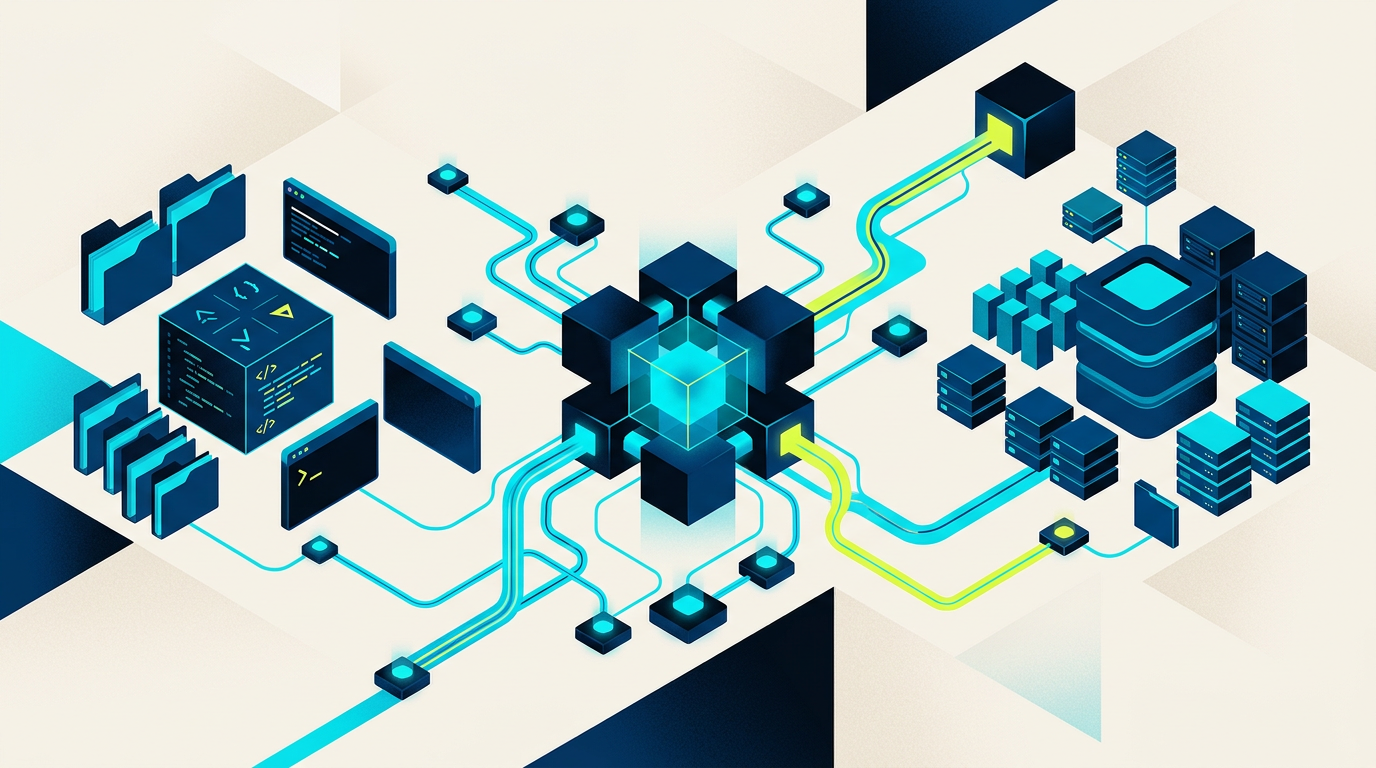
An MCP architecture consists of three primary layers:
- The MCP Host: The application the user is interacting with (e.g., an AI IDE like Cursor, a desktop AI assistant, or a custom internal chatbot).
- The MCP Client: The internal mechanism within the host application that negotiates the connection and translates the AI's requests into the standardized protocol.
- The MCP Server: A lightweight, specialized program connected directly to a specific data source (like a SQL database, a Slack workspace, or a GitHub repository). The server exposes data and capabilities to the client securely.
What Exactly Does an MCP Server Expose?
When you integrate a tool using MCP, you are fundamentally exposing three types of primitives to the AI:
- Resources: File-like data meant to be read by the AI to gain context. This could be a specific customer record in Salesforce, an API documentation file, or application logs.
- Prompts: Reusable, parameterized templates that help users quickly instruct the AI on how to interact with the server's data.
- Tools: Executable functions that allow the AI to take action. For example, a tool might allow the AI to execute a specific SQL query, create a Jira ticket, or merge a pull request.
Deep Dive: Setting Up a GitHub MCP Server
One of the most powerful and widely adopted use cases for development teams in 2026 is the GitHub MCP server.
Before MCP, allowing an AI assistant to review code or manage issues required granting extensive OAuth permissions to third-party AI platforms, or building complex, fragile CI/CD pipelines hooked into custom scripts.
With a GitHub MCP server running locally or securely within your virtual private cloud (VPC), your AI assistant can seamlessly interact with your repositories while you maintain complete control over access tokens and data egress.
Core Capabilities of a GitHub MCP Server
A properly configured GitHub MCP server exposes several critical tools to an AI agent:
- Code Search & Reading: The AI can search for specific functions across multiple repositories to understand dependencies before suggesting a code change.
- Pull Request Management: The agent can read PR diffs, analyze the changes against internal style guidelines, and draft review comments.
- Issue Tracking: The AI can query open issues, link them to relevant code files, and even generate a scaffolded fix based on the issue description.
- Action Execution: Triggering GitHub Actions workflows directly from the chat interface.
5 Steps to Implement a GitHub MCP Server
For teams looking to integrate this into their workflow, the deployment process generally follows these steps:
- Environment Preparation: Ensure your host application (like Claude Desktop or an enterprise AI wrapper) supports MCP clients.
- Server Installation: Install the official or community-maintained GitHub MCP server package via npm, pip, or Docker.
- Authentication Setup: Generate a GitHub Personal Access Token (PAT) with granular scopes (e.g.,
repo,read:org). Never use administrative tokens. Restrict the token's access to only the repositories the AI explicitly needs. - Configuration Configuration: Update your AI host's configuration file (often a JSON file managing MCP connections) to point to the server executable and pass the PAT as an environment variable.
- Testing the Connection: Restart the host application and ask the AI a prompt like, "What are the open pull requests in the [Repo Name] repository?" If configured correctly, the AI will use the MCP tool to query GitHub and return the live data.
Ecosystem Compatibility: Does ChatGPT Support Model Context Protocol MCP?
A frequent question among enterprise IT leaders evaluating AI infrastructure is: Does ChatGPT support model context protocol MCP?
Because MCP was originally spearheaded by Anthropic (the creators of Claude), native, out-of-the-box support was initially heavily skewed toward the Claude ecosystem and developers using AI-first IDEs. However, by 2026, the landscape has evolved into a broader open standard.
While OpenAI has its own robust ecosystem of Custom GPTs and custom function-calling APIs, the broader developer community rapidly embraced MCP because it prevents vendor lock-in.
As of 2026, leveraging MCP with OpenAI models is typically achieved through:
- Third-Party MCP Clients: Enterprise AI platforms and custom desktop applications that use OpenAI's API under the hood, but utilize their own MCP client layer to handle the data connections.
- Open-Source Middleware: Frameworks that translate OpenAI's native function-calling format into standard MCP requests, allowing teams to use a single set of MCP servers regardless of whether they are routing prompts to GPT-4, Claude 3.5, or a local Llama model.
Ultimately, MCP is model-agnostic. The protocol defines how the client and server talk to each other, not how the LLM generates its response. As long as the host application can interpret the LLM's tool-use requests and map them to the MCP standard, any model can utilize an MCP server.
Custom API Integrations vs. MCP Standard
Why should a business invest in building MCP servers rather than sticking to traditional API webhooks or proprietary plugin ecosystems? The answer lies in scalability and maintenance.
| Feature | Traditional Custom API Integration | Model Context Protocol (MCP) |
|---|---|---|
| Model Lock-In | High. Often requires rewriting logic for OpenAI vs. Anthropic vs. Google. | Low. Write the server once; any MCP-compatible client can connect to it. |
| Context Management | Manual. Developers must build systems to chunk and feed data to the LLM. | Native. MCP handles the formatting of Resources and Tools for optimal LLM ingestion. |
| Security & Access | Complex. Requires building custom authentication layers for the AI to access the API. | Standardized. MCP servers run locally or in controlled VPCs, retaining existing enterprise auth. |
| Development Speed | Slow. Requires custom middleware for every new data source. | Fast. Standardized SDKs allow developers to expose new databases in hours. |
Building Custom Tool Integrations for Your Business
At PixelorCode, we frequently partner with enterprise clients to design and deploy custom AI architectures. One of the most common bottlenecks we solve is data accessibility. Off-the-shelf LLMs are incredibly smart, but they are completely ignorant of your company's proprietary data until you build the bridge.
Building a custom tool integration via MCP requires a strategic approach:
1. Identify High-Value Data Silos
Look for areas where your team spends the most time switching context. Common targets include proprietary ERP systems, legacy SQL databases, internal knowledge bases (like Notion or Confluence), and customer support ticketing platforms.
2. Define the AI's Boundaries (Read vs. Write)
When designing an MCP server, start with read-only access. Expose Resources that allow the AI to read customer histories or internal wikis. Only after the read-only phase has been thoroughly audited should you introduce Tools that allow the AI to execute actions (like updating a database record or sending an email).
3. Implement Robust Security Controls
MCP servers are powerful, which means they require strict security governance.
- Principle of Least Privilege: An MCP server should only have access to the exact data the AI needs to function. If you build a database MCP server, use a database user account that is restricted to specific tables and strictly forbidden from executing
DROPorDELETEcommands. - Human-in-the-Loop (HITL): For any MCP tool that performs a destructive or outward-facing action (like merging a codebase or sending a client invoice), the host application should require explicit human approval before the tool executes the command.
- Local vs. Remote: Decide where the server lives. Local MCP servers run on the user's machine and inherit the user's local permissions (great for developer tools). Remote MCP servers run in the cloud and utilize service accounts (ideal for shared enterprise chatbots).
The Future of AI Workflows in 2026
The widespread adoption of the Model Context Protocol signifies the maturation of artificial intelligence in the workplace. We are no longer amazed by an AI that can write a generic poem; we expect AI to act as a competent, context-aware digital colleague.
By standardizing how AI interacts with the digital world, MCP removes the technical friction of integrating tools. Whether you are setting up a straightforward GitHub MCP server to accelerate your engineering team, or building a bespoke fleet of MCP servers to connect a fragmented enterprise architecture, embracing this protocol is critical for scaling AI ROI in 2026.
Frequently Asked Questions (FAQ)
What is model context protocol MCP in AI?
The Model Context Protocol (MCP) is an open standard that dictates how artificial intelligence models securely connect to, read from, and interact with external data sources and software tools. It eliminates the need to build custom, platform-specific integrations for every different LLM.
What is an MCP server?
An MCP server is a lightweight software application that connects directly to a specific data source (like a database, a SaaS platform, or a local file system) and exposes that data in a standardized format that any MCP-compatible AI client can understand and utilize.
Does ChatGPT support model context protocol MCP?
While MCP was originally developed by Anthropic, it is an open standard. ChatGPT and OpenAI models can interact with MCP servers if they are accessed through a host application, IDE, or middleware platform that features an MCP client to handle the protocol translation.
How does model context protocol work with secure enterprise data?
MCP enhances security by allowing the data source to dictate the rules. Instead of sending all your private data to a cloud LLM, an MCP server sits inside your secure network (or on your local machine) and only passes the specific context the AI requests at that exact moment, retaining your existing firewalls and access controls.
Transforming your operations with AI requires more than just API keys—it requires a secure, scalable architecture. At PixelorCode, our technical teams specialize in custom AI automation, building secure MCP servers and integrating enterprise data silos to drive real ROI. Contact us today to discuss your custom AI integration strategy.