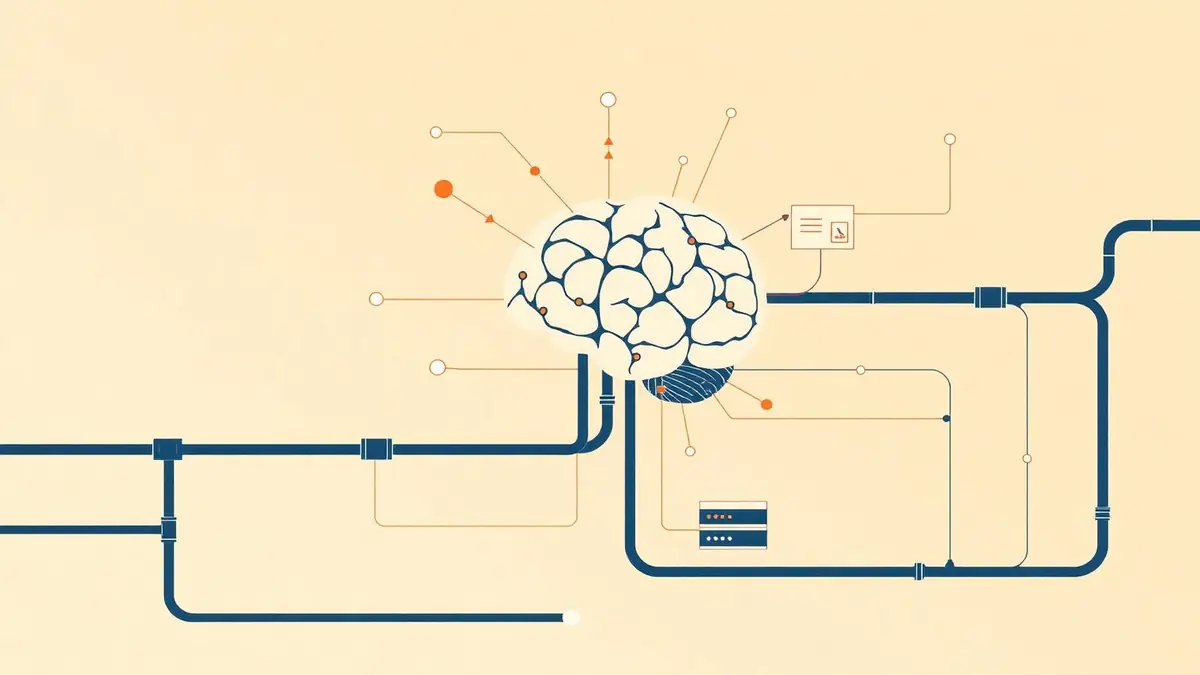
The Model Context Protocol (MCP) is an open standard designed to securely connect large language models (LLMs) and AI agents to external data sources, developer tools, and operational environments. Introduced initially by Anthropic and rapidly adopted across the wider AI ecosystem, MCP eliminates the need to build and maintain fragmented, custom API wrappers for every individual AI model or platform. By standardizing how context, prompt templates, and executable tools are exposed to AI clients, MCP serves as the universal interface—often described as the "USB-C port" for enterprise AI integrations.
For engineering teams, agency builders, and technical founders, understanding what an MCP server is and how the protocol operates is essential for designing resilient AI architectures in 2026 and beyond.
What Is MCP Model Context Protocol in AI?
Before MCP, connecting an AI model to an internal database, a GitHub repository, or a project management system required proprietary glue code. If you wanted Claude, ChatGPT, Cursor, and custom internal agents to query your PostgreSQL database, you had to write custom tool-calling definitions and authentication middleware for each individual client or framework (such as LangChain, LlamaIndex, or proprietary vendor SDKs).
When APIs changed, authentication expired, or new models were released, these bespoke connections broke easily.
MCP solves this M×N integration problem. Instead of writing $M$ integrations for $N$ different models, developers build a single MCP server for each data source or tool. Any AI application that speaks the MCP protocol (an MCP client) can instantly discover, read, and invoke capabilities on that server.
[ Traditional Approach ]
Claude Client    ─── Custom Integration ───▶ GitHub
ChatGPT Client   ─── Custom Integration ───▶ PostgreSQL
Cursor / IDE     ─── Custom Integration ───▶ Slack
(Fragile, M × N custom API wrappers)

[ MCP Architecture ]
Claude / IDE / Agents (MCP Clients)
         │
         ▼  Standardized JSON-RPC Protocol
 ┌─────────────────────────────────────────┐
 │               MCP SERVERS               │
 ├──────────────┬──────────────┬───────────┤
 │  GitHub MCP  │ Postgres MCP │ Slack MCP │
 └──────────────┴──────────────┴───────────┘
How Does Model Context Protocol Work?
At its technical core, the mcp protocol uses a client-server architecture built on top of JSON-RPC 2.0. It standardizes bidirectional communication over local transport layers (such as standard input/output (stdio) for local desktop processes) as well as remote transport mechanisms like Server-Sent Events (SSE) and WebSockets over HTTP.
The protocol defines three core primitives that an MCP server can expose to an AI client:
1. Resources (Passive Context)
Resources are read-only data payloads that provide passive context to the model. They behave much like standard REST endpoints or file paths (e.g., postgres://prod-db/schema or file:///workspace/docs/architecture.md). Resources can be text-based (code, documentation, SQL schemas, markdown notes) or binary (images, PDFs, audio). Clients can subscribe to resource updates, allowing the AI to maintain real-time situational awareness as underlying files or databases change.
2. Tools (Executable Actions)
Tools allow an LLM to take real-world actions with user consent. An MCP server defines tool definitions with strict JSON Schema inputs and executable endpoints. Examples include running a database migration, executing a test suite in Docker, opening a pull request, or dispatching a customer communication. The AI client requests tool execution; the MCP host executes it within its security boundaries and returns the structured output.
3. Prompts (Contextual Blueprints)
Prompts are structured, pre-defined prompt templates and conversational workflows exposed by the server. They allow domain experts to define prompt patterns—such as a standardized code-review workflow or a security audit checklist—that clients can trigger dynamically.
What Is an MCP Server?
An MCP server is a lightweight application or background process that exposes specific data stores, services, or APIs using the Model Context Protocol specifications.
MCP servers can run locally on a developer's machine (interfacing with local SQLite databases, local git repositories, or file systems) or in production cloud environments (interfacing with cloud infrastructure, CRM systems, analytics pipelines, and secure internal microservices).
Core Responsibilities of an MCP Server
- Capability Negotiation: During the initial handshake with the client, the server advertises whether it supports resources, tools, prompts, or real-time event notifications.
- Schema Validation: It validates all incoming parameters against JSON Schema specifications before running business logic.
- Isolation & Sandboxing: It restricts what the LLM can see and touch, enforcing access control, credential management, and scoped permissions.
- Standardized Responses: It formats raw API responses into structured markdown or JSON payloads optimized for LLM token efficiency.
Open-Source Ecosystem: GitHub MCP Servers and Tooling
The open-source ecosystem surrounding MCP has expanded rapidly. Developers can find pre-built, production-ready servers in community repositories, official SDKs (TypeScript/JavaScript, Python, Kotlin), and on GitHub MCP registries.
| MCP Server Category | Common Implementations | Typical Use Cases |
|---|---|---|
| Development & DevOps | GitHub MCP, GitLab, Docker, Kubernetes, Sentry | PR reviews, issue triage, automated debugging, CI/CD pipeline diagnosis |
| Databases & Storage | PostgreSQL, SQLite, Snowflake, BigQuery, Redis | Natural-language querying, schema introspection, automated migration checks |
| Enterprise Communication | Slack, Notion, Google Workspace, Linear, Jira | Automated task updates, asynchronous summary generation, cross-app search |
| System & Local Tools | Filesystem, Brave Search, Puppeteer, Memory | Local code manipulation, web scraping, multi-session context persistence |
Because these servers adhere strictly to the open protocol specification, a single GitHub MCP server configured on your workstation can serve Claude Desktop, an IDE-based assistant like Cursor or Windsurf, and custom terminal CLI agents simultaneously.
Architecture Comparison: MCP vs. Traditional Custom Integrations
Understanding when to build an MCP server versus a traditional custom tool integration is a critical architectural decision for tech companies and automation architects.
| Feature | Traditional Custom AI Function Calling | Model Context Protocol (MCP) Architecture |
|---|---|---|
| Interoperability | Vendor-locked (tied to OpenAI functions, Anthropic tool use, or custom LangChain agents) | Vendor-agnostic (pluggable across Claude, open-source models, and IDEs) |
| Maintenance Overhead | High (every client change requires rewriting wrappers) | Low (write the server once; all compatible clients connect) |
| Security & Permissions | Hardcoded or ad-hoc authorization flows | Standardized client-level approval prompts and isolated process boundaries |
| Context Discovery | Hardcoded token injection or manual RAG | Dynamic resource inspection, pagination, and subscription-based updates |
| Local & Cloud Flexibility | Usually cloud-API reliant | Seamless support for local stdio processes and remote SSE endpoints |
Step-by-Step: How to Plan and Implement an Enterprise MCP Server
If you are planning to expose internal enterprise data or business workflows to AI agents, follow this structured engineering roadmap:
[1. Scope Boundaries] ──▶ [2. Choose Transport] ──▶ [3. Define JSON Schema] ──▶ [4. Implement Auth] ──▶ [5. Test & Monitor]
Step 1: Scope the Boundaries and Capabilities
Determine what the AI agent genuinely needs to accomplish. Avoid exposing unrestricted root access or raw database write commands. Separate read operations (exposed as Resources) from state-mutating operations (exposed as Tools).
Step 2: Select the Right Transport Layer
- Local Development / Desktop: Choose
stdiotransport. The client spawns the server as a child process and communicates through standard input/output streams. This avoids network overhead and simplifies local credential handling. - Distributed Systems / Cloud Services: Choose HTTP with Server-Sent Events (SSE). This allows long-lived connections, remote microservice hosting, and centralized authentication.
Step 3: Implement Strict Schema Validation and Guardrails
Define precise JSON Schemas for all input parameters. If a tool accepts an identifier, enforce regex patterns, integer ranges, and explicit enums. Add server-side safety checks that reject destructive operations (e.g., dropping database tables or bulk-deleting customer records) regardless of what the LLM requests.
Step 4: Configure Robust Authentication and Human-in-the-Loop Controls
For tools that perform high-risk actions—such as sending customer emails, modifying billing configurations, or executing code in production—implement human-in-the-loop (HITL) confirmations within your client interface. Keep API keys, access tokens, and database credentials inside the MCP server environment; never pass raw credentials into the model's context window.
Step 5: Test with Model Context Protocol Inspector and Monitor Token Consumption
Anthropic and the open-source community provide interactive debugging tools like the @modelcontextprotocol/inspector. Use these utilities to inspect JSON-RPC message frames, test schema parsing, and measure token payload sizes before deploying into production.
At PixelorCode, our technical team designs and integrates custom AI automation systems, secure MCP microservices, and modern web architectures that give scaling tech businesses a sustainable competitive edge.
Security Best Practices for MCP Deployments
While MCP solves integration fragmentation, connecting AI models directly to operational infrastructure introduces distinct security vectors:
- Prompt Injection Defense: External resources (like scraped web pages or unvetted customer emails) might contain prompt injections designed to hijack the model's tool-calling logic. Always treat incoming resource text as untrusted data.
- Least Privilege Principles: Run MCP servers in isolated containers with minimal network and database permissions. A read-only analytics agent should connect to a read-replica database user with strict row-level security.
- Rate Limiting and Circuit Breakers: Protect downstream third-party APIs by setting rate limits within the MCP server layer to prevent infinite tool loops caused by model hallucination or unexpected recursive calls.
- Audit Logging: Log every incoming JSON-RPC tool invocation, the parsed arguments, the executing model identity, and the server execution outcome for compliance and forensic analysis.
Frequently Asked Questions
What is the Model Context Protocol (MCP) in simple terms?
Model Context Protocol is an open-source standard that acts as a universal bridge between AI assistants and external systems (like databases, GitHub repositories, local files, and web APIs). Instead of building custom code for each AI tool, developers build one MCP server that works across compatible AI clients.
Does ChatGPT support Model Context Protocol (MCP)?
As of 2026, the broader AI ecosystem—including open-source developer tooling, IDEs, and major model hosts—has embraced MCP or builds compatibility bridges. While Anthropic originally authored the specification for Claude Desktop and Claude CLI, developers can connect OpenAI models and custom ChatGPT-based enterprise agents to MCP servers using open-source adapters and multi-agent orchestration frameworks.
What is the difference between an MCP Client and an MCP Server?
An MCP Client is the AI interface or host application (such as Claude Desktop, an IDE extension like Cursor, or an autonomous workflow runner) that requests data and decides when to call tools. An MCP Server is the backend service that securely accesses the target data source (like PostgreSQL, Jira, or a local file system) and executes the requested operations.
How does MCP differ from standard REST APIs?
REST APIs require the client application to know specific URL endpoints, HTTP methods, and manual payload construction. MCP abstracts these operations into a unified JSON-RPC protocol where capabilities, schemas, prompt templates, and real-time resource changes are dynamically discoverable by AI models in a standardized format.
Building Future-Proof AI Systems
The Model Context Protocol marks a fundamental maturation point in how AI software is engineered. By decoupling models from proprietary tool definitions, organizations can build flexible, modular data pipelines that remain resilient even as underlying LLM providers evolve.
If your organization is looking to streamline AI tool integrations, build custom MCP infrastructure, or modernize your web applications with intelligent automation, get in touch with the PixelorCode team to design an architecture built for performance and scale.